Sunday, 15 May 2016

A Trip Down Hayley Lane

When you live somewhere for long enough it becomes increasingly uncommon that you come across an undiscovered gem right on your doorstep, but this month we did just that. Just a quarter of an hour away by car from Papworth, the beautiful Hayley Wood lies concealed down a secluded path. At this time of year it is brimming with resplendent bluebells and dainty wood anemones, and the distinctive chatter of chiffchaffs and laughter of woodpeckers punctuate the calm air. It is also an excellent place to try to catch sight of adorable podgy treecreepers and camouflaged spotted flycatchers.


The wood is carefully managed to ensure that a variety of habitats are available for many woodland species. As well as birds, the wood is home to mammals such as badgers and foxes, and a wide range of invertebrates, notably a rich array of butterflies including the elusive silver-washed fritillary. With habitats ranging from coppiced woodland to mature trees and from open glades to ponds a multitude of niches have been created to promote biodiversity.


However, not all species are equally welcome in the wood. As part of their management work, the Wildlife Trust have erected a fence to exclude deer from the majority of the wood. With their cute little faces deer look too innocent to be any trouble, but unfortunately they cause havoc to ecosystems, foraging on the undergrowth and damaging the structure and regeneration capabilities of woodland, so the fencing is an important step towards limiting their destruction of this ancient woodland.


Woodland has been present on some parts of the site since prehistoric times but there are areas which still bear the marks of a much more recent history. As you first enter the wood you will find yourself in a section referred to as “The Triangle”. It is easy to get distracted here by the first enchanting sight of the wood but if you look carefully you will see the ridges and furrows left from the time when this area was regularly ploughed prior to the agricultural depression in the late 19th/early 20th century. At this time large swathes of agricultural land were abandoned as farming became unprofitable. Over time the land that was left untouched underwent a gradual succession, which took it from farmland to woodland. I find it fascinating to stand in “The Triangle” and think about the changes which have occurred here since nature was allowed to take over around 100 years ago.


At only 52 hectares Hayley Wood is admittedly diminutive in size, but what it lacks in area it makes up for in biotic diversity, natural beauty and an all-encompassing sense of calm. So next time you fancy getting away from it all, you could do a lot worse than taking a trip down the inconspicuous Hayley Lane.


Monday, 21 March 2016

Signs of Spring

It’s official – spring is here! I may have been overly optimistically trying to find signs of spring since early February but now no one can deny the distinctive indications of the season’s onset. Our humble back garden has yet again been transformed into a birdwatcher’s treat. The suet balls and birdseed are requiring restocking at an ever increasing rate as blue, great and long-tailed tits visit our bird restaurant on what seems like an hourly basis – not that we mind, it is so fascinating to watch them feed.


We have also revelled in watching different birds check out the variety of bird boxes in our garden. It really does look like they are attending a house viewing as humans might. They pop in, have a look around, decide whether it is right for them, and if they like it they might come back to see it a couple more times before moving in. We have been lucky enough this year to see a pair of robins go from their first viewings to settling into their new home. What to us looks like just a small wooden box, is to them the perfect place to lay and incubate their eggs and raise their chicks for the first few weeks of their lives. We have been delighted to watch as the couple furnish their new abode with the leaves and bits of moss that they have snaffled from the undergrowth, and without wanting to anthropomorphise them it is hard to watch the male feeding the female without being struck by how cute the situation is.


But it’s not just in your garden where you can see spring unfolding. Around our village right now there are so many fresh signs that nature is waking up and shaking off the sleepiness of winter. If you have been near the playing fields recently, you may have heard a loud repetitive hollow hammering noise. Despite the volume sounding like it belongs to a distant building site, this is the sound of great-spotted woodpeckers claiming their territory and foraging for invertebrates. If you keep an eye out you might even spot one of these impressive black, white and red birds dipping and darting across the fields on their way to another tree.


The butterflies, too, are making it known that spring is here. If you head to the woods or the agricultural fields you may spot some of the butterflies which start to emerge in April, such as brimstones, large and small whites, peacocks and commas, to name but a few. And if you’re in the woods, you should definitely stop to admire the carpets of dazzling azure bluebells, they really are a spectacular sight.


Nature is magnificent all year round but I have to admit that spring is particularly special to me. The country slowly starts to turn green again, wildflowers bloom with gusto, and the air is alive with the melodious singing of birds and the fluttering of insects. What’s not to love?


Sunday, 3 January 2016

A Woodland Wonderland

A few weeks ago, after a long day at work, I came home to a very exciting surprise in my porch. It was in a satisfyingly thick and heavy brown envelope, making it clear that it wasn’t just my regular run-of-the-mill post. I eagerly opened it up and found that my Mum had bought me a Wildlife Trust membership as an early Christmas present. Inside was a plethora of exciting booklets, showing all the reserves in the area, and as it turns out there are far more than I knew about. So armed with lots of new places to explore, we decided to get straight outside that weekend and discover a new local gem – Brampton Woods!


At just over 130 hectares, Brampton Woods is Cambridgeshire’s second largest woodland. When we first visited, despite it being very late autumn, a surprising number of trees still retained green leaves. These were juxtaposed with the vast array of brilliantly coloured autumnal leaves which were either still hanging tentatively from their branches or had dropped to form a cushioned carpet on the ground. The paths vary between wide open rides for easy walking to slightly more meandering and bumpy tracks for a feeling of rambling “off-piste”.


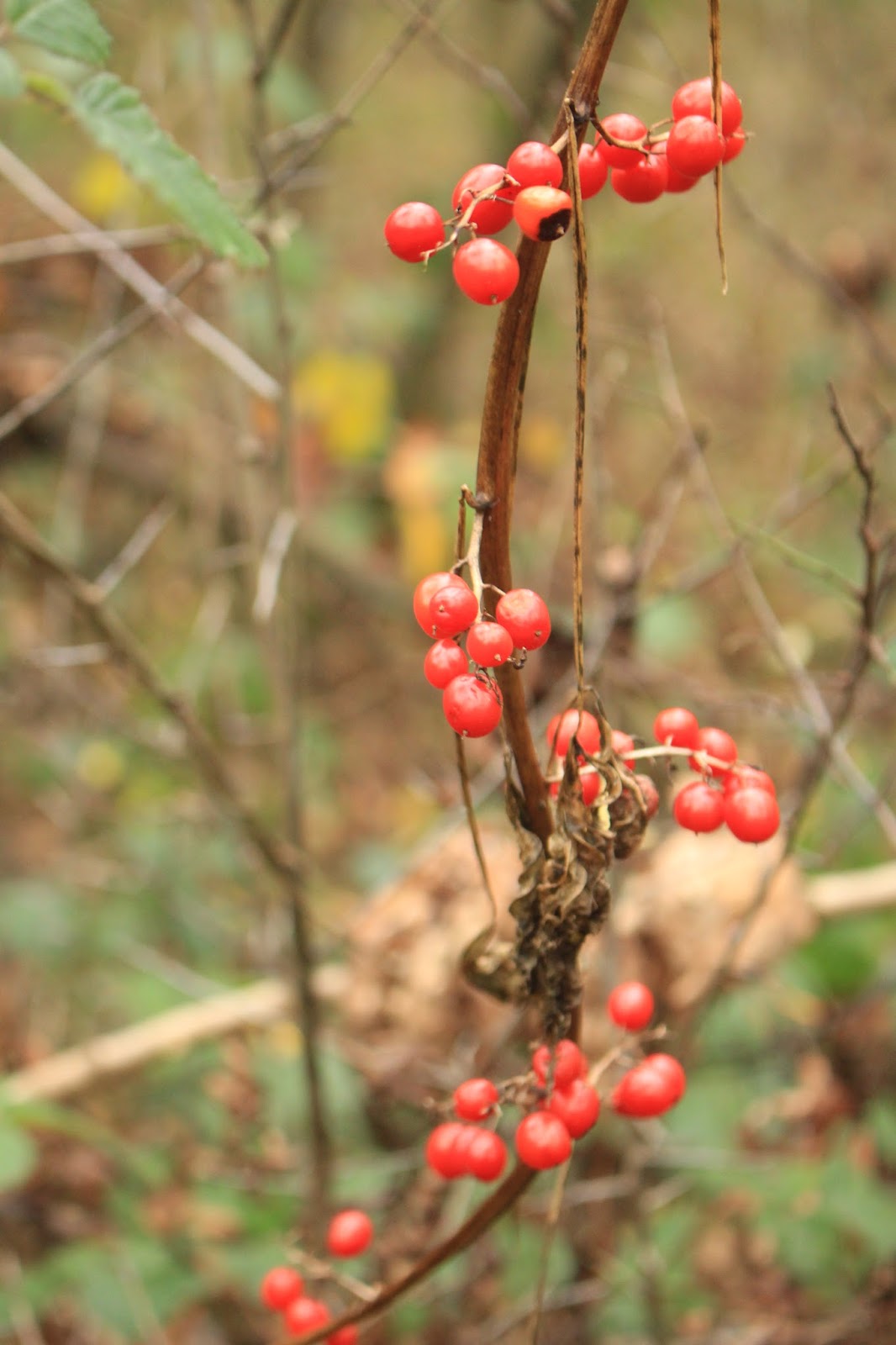
Now that the craziness of Christmas and New Year has passed, we are back to our normal routine so decided to take the time today to revisit Brampton to see how winter is treating it. Gone are the autumnal colours, now the only green belongs to brambles and pines. But let’s not just focus on the lack of leaves, there are so many other bright and beautiful things to see in the woods at this time of year. Bright glistening crimson berries of honeysuckle are omnipresent, sitting proudly on unrelated plants which the honeysuckle has managed to entwine its way around and climb up. Glossy scarlet rosehips also decorate the area, hanging tantalisingly like freshly polished rubies from wild rose bushes. Then, of course, there is lichen: wonderful, polychromatic, multi-textured lichen. This is like the woodland’s wallpaper. Bark and rocks are transformed by the kaleidoscopic whites, greens, oranges and yellows of this fascinating organism.


It is not just the plants which are a source of excitement in winter. Brampton is frequented by multitudes of resident birds and winter migrants, such as redwings and fieldfares. The woodland habitat is managed for the benefit of nature, and from the impressive number of species that have been recorded at the site it is clear that it is working. Perhaps most excitingly, the woods are home to a number of dormice. This sleepy little mammal is nocturnal and hibernates throughout the winter so you would be very lucky to see one. Brampton Woods is a particularly special place for dormice because they were only reintroduced here in 1993, and it was the first site in the UK’s reintroduction programme. The woods are perfect for these indecently adorable creatures – the vast variety of trees provides them with ample food sources, from the hazelnuts and sloe berries that grow on the branches, to the insects which crawl along the bark. Wandering through the woods, we spotted a number of special dormouse nesting boxes hanging from trees; obviously it is important to remember to marvel from afar because it is illegal to disturb a dormouse’s nesting place.


This ancient woodland feels a million miles away from the hustle and bustle of daily life. It has stood here for around 900 years, witnessed people come and go, watched trends ebb and flow. It is a good reminder of the permanence of the wonder of nature – a feeling that transcends time and location.

Saturday, 26 December 2015

An Unexpected Surprise


After a coursework deadline induced hiatus, we’re finally back and blogging! Last weekend we decided to revisit a favourite old haunt, Wicken Fen, in the hope of spotting the elusive short-eared owls at dusk. If you have been reading this blog for a while, you will have seen that we had some luck in seeing them earlier in the year.


Getting a good view of owls hunting is thrilling. Their graceful surveys of the area and high-speed, high-precision darts to the ground are extraordinary. But they can be picky creatures, favouring still, dry evenings. In the stark flatlands of East Anglia, this makes choosing the perfect evening to spot them somewhat tricky. We live about half an hour away from Wicken so at best we can guess based on our weather and the forecast what the conditions will be like there. On our most recent visit we got it slightly wrong. It was a beautiful evening but deceptively blustery. “You won’t see much out there tonight, too much wind”, muttered a birder who had ventured further onto the Fen but was now returning, defeated, to his car.


Slightly disheartened, we continued nonetheless towards a spot where we have seen the owls before. As we stood waiting, with the wind battering our faces, we started to lose hope of spying the fleeting birds. Then all of a sudden, in a ghostly flash, a barn owl rose from behind the bank of the lode and darted into the russet undergrowth. This wasn’t the type of owl we had come looking for, but obviously we were delighted. Despite the gusts, we watched entranced for a few minutes as the barn owl stealthily hunted. Then, just as suddenly as he appeared, he shot down below the raised bank and out of sight.


We thought that we had been lucky for this brief show and assumed that we probably weren’t going to be in for any more treats. But we were wrong. Just minutes after the barn owl had disappeared, a large bird appeared from behind us and shot behind the bushes. We were pretty sure what we had seen but the apparition had been so brief and unexpected that we had to wait to be sure. As the bird rose again from behind the foliage, his black eye mask, wide facial disk and piercing yellow eyes gave away his identity. At last, a short-eared owl!


He too stayed for only a few minutes to hunt, before darting into the distance, his image dissolving into the darkening sky. I was a little disappointed that we didn’t have the opportunity to get any good photos of the owls but generally pleased that the unfavourable conditions hadn’t entirely deprived us of an encounter with these striking birds.


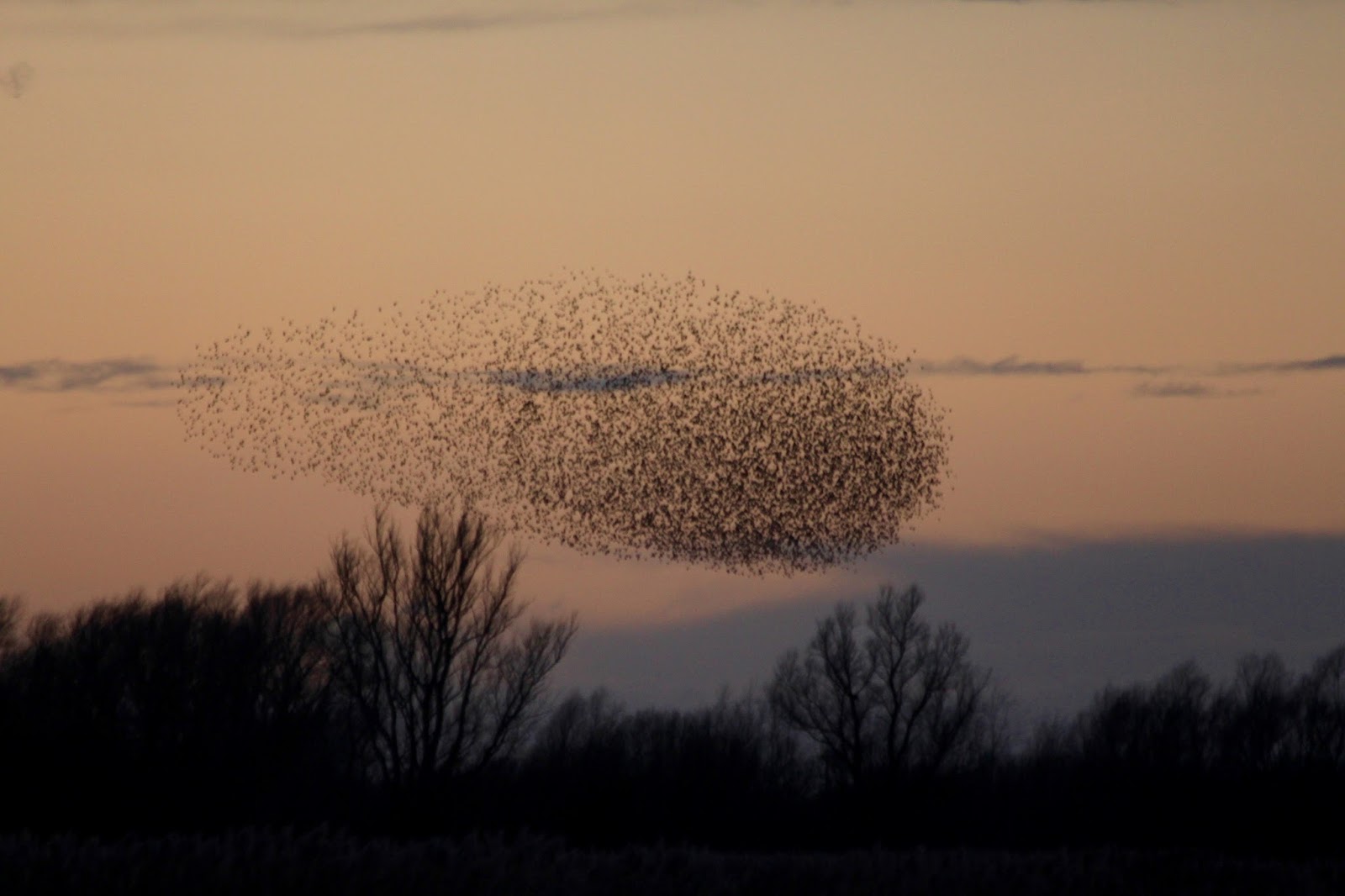
As we were about to leave, I noticed out of the corner of my eye a fluid black mass dancing in the sky, far in the distance. A mighty murmuration of thousands of starlings was sweeping through the air, each bird synchronised with the one beside it, as though all the birds had combined to become one entity. As this was my first murmuration sighting, I was particularly enthralled. The mass twirled throughout the sky, becoming at times nearly invisible and then suddenly bold and inky as they turned all at once in their harmonised flight. Gradually the mass decreased, as from time-to-time small groups broke off and shot down into the trees to go to sleep. We kept anticipating that the whole conglomeration was about to disappear as they would teasingly dip close to the treetops, but then at the last minute shoot up again. As we watched enraptured, it was suddenly as if a responsible starling had called “LIGHTS OUT IN 5 MINUTES!” because the airborne assembly all at once dived for the nearest woodland canopy. The starlings knew that it was time for bed and had sunk into the trees to roost for the night. We took their departure as a cue for us to leave.


This is one of the things that I love about nature – its unpredictability. We had come out with our minds set on finding owls, but were also treated to one of the most beautiful, entrancing, and moving displays that this country has to offer, on a reserve which isn’t even famous for its spectacular murmurations. It just goes to show that you shouldn’t immediately lose heart if your target species is being elusive – there might be something even more spectacular just around the corner.