Sunday, 3 January 2016

A Woodland Wonderland

A few weeks ago, after a long day at work, I came home to a very exciting surprise in my porch. It was in a satisfyingly thick and heavy brown envelope, making it clear that it wasn’t just my regular run-of-the-mill post. I eagerly opened it up and found that my Mum had bought me a Wildlife Trust membership as an early Christmas present. Inside was a plethora of exciting booklets, showing all the reserves in the area, and as it turns out there are far more than I knew about. So armed with lots of new places to explore, we decided to get straight outside that weekend and discover a new local gem – Brampton Woods!


At just over 130 hectares, Brampton Woods is Cambridgeshire’s second largest woodland. When we first visited, despite it being very late autumn, a surprising number of trees still retained green leaves. These were juxtaposed with the vast array of brilliantly coloured autumnal leaves which were either still hanging tentatively from their branches or had dropped to form a cushioned carpet on the ground. The paths vary between wide open rides for easy walking to slightly more meandering and bumpy tracks for a feeling of rambling “off-piste”.


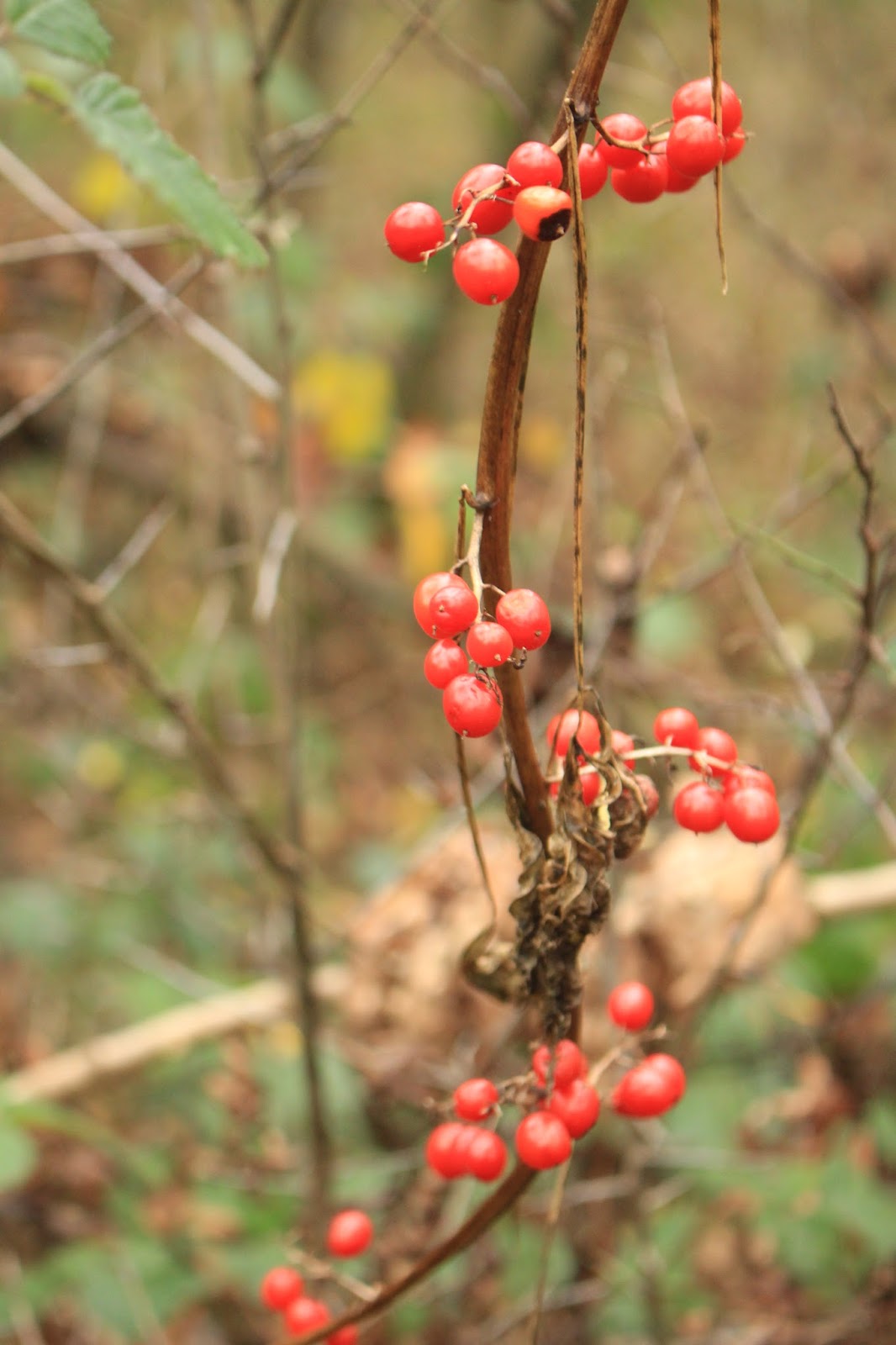
Now that the craziness of Christmas and New Year has passed, we are back to our normal routine so decided to take the time today to revisit Brampton to see how winter is treating it. Gone are the autumnal colours, now the only green belongs to brambles and pines. But let’s not just focus on the lack of leaves, there are so many other bright and beautiful things to see in the woods at this time of year. Bright glistening crimson berries of honeysuckle are omnipresent, sitting proudly on unrelated plants which the honeysuckle has managed to entwine its way around and climb up. Glossy scarlet rosehips also decorate the area, hanging tantalisingly like freshly polished rubies from wild rose bushes. Then, of course, there is lichen: wonderful, polychromatic, multi-textured lichen. This is like the woodland’s wallpaper. Bark and rocks are transformed by the kaleidoscopic whites, greens, oranges and yellows of this fascinating organism.

It is not just the plants which are a source of excitement in winter. Brampton is frequented by multitudes of resident birds and winter migrants, such as redwings and fieldfares. The woodland habitat is managed for the benefit of nature, and from the impressive number of species that have been recorded at the site it is clear that it is working. Perhaps most excitingly, the woods are home to a number of dormice. This sleepy little mammal is nocturnal and hibernates throughout the winter so you would be very lucky to see one. Brampton Woods is a particularly special place for dormice because they were only reintroduced here in 1993, and it was the first site in the UK’s reintroduction programme. The woods are perfect for these indecently adorable creatures – the vast variety of trees provides them with ample food sources, from the hazelnuts and sloe berries that grow on the branches, to the insects which crawl along the bark. Wandering through the woods, we spotted a number of special dormouse nesting boxes hanging from trees; obviously it is important to remember to marvel from afar because it is illegal to disturb a dormouse’s nesting place.


This ancient woodland feels a million miles away from the hustle and bustle of daily life. It has stood here for around 900 years, witnessed people come and go, watched trends ebb and flow. It is a good reminder of the permanence of the wonder of nature – a feeling that transcends time and location.

Saturday, 26 December 2015

An Unexpected Surprise


After a coursework deadline induced hiatus, we’re finally back and blogging! Last weekend we decided to revisit a favourite old haunt, Wicken Fen, in the hope of spotting the elusive short-eared owls at dusk. If you have been reading this blog for a while, you will have seen that we had some luck in seeing them earlier in the year.


Getting a good view of owls hunting is thrilling. Their graceful surveys of the area and high-speed, high-precision darts to the ground are extraordinary. But they can be picky creatures, favouring still, dry evenings. In the stark flatlands of East Anglia, this makes choosing the perfect evening to spot them somewhat tricky. We live about half an hour away from Wicken so at best we can guess based on our weather and the forecast what the conditions will be like there. On our most recent visit we got it slightly wrong. It was a beautiful evening but deceptively blustery. “You won’t see much out there tonight, too much wind”, muttered a birder who had ventured further onto the Fen but was now returning, defeated, to his car.


Slightly disheartened, we continued nonetheless towards a spot where we have seen the owls before. As we stood waiting, with the wind battering our faces, we started to lose hope of spying the fleeting birds. Then all of a sudden, in a ghostly flash, a barn owl rose from behind the bank of the lode and darted into the russet undergrowth. This wasn’t the type of owl we had come looking for, but obviously we were delighted. Despite the gusts, we watched entranced for a few minutes as the barn owl stealthily hunted. Then, just as suddenly as he appeared, he shot down below the raised bank and out of sight.


We thought that we had been lucky for this brief show and assumed that we probably weren’t going to be in for any more treats. But we were wrong. Just minutes after the barn owl had disappeared, a large bird appeared from behind us and shot behind the bushes. We were pretty sure what we had seen but the apparition had been so brief and unexpected that we had to wait to be sure. As the bird rose again from behind the foliage, his black eye mask, wide facial disk and piercing yellow eyes gave away his identity. At last, a short-eared owl!


He too stayed for only a few minutes to hunt, before darting into the distance, his image dissolving into the darkening sky. I was a little disappointed that we didn’t have the opportunity to get any good photos of the owls but generally pleased that the unfavourable conditions hadn’t entirely deprived us of an encounter with these striking birds.


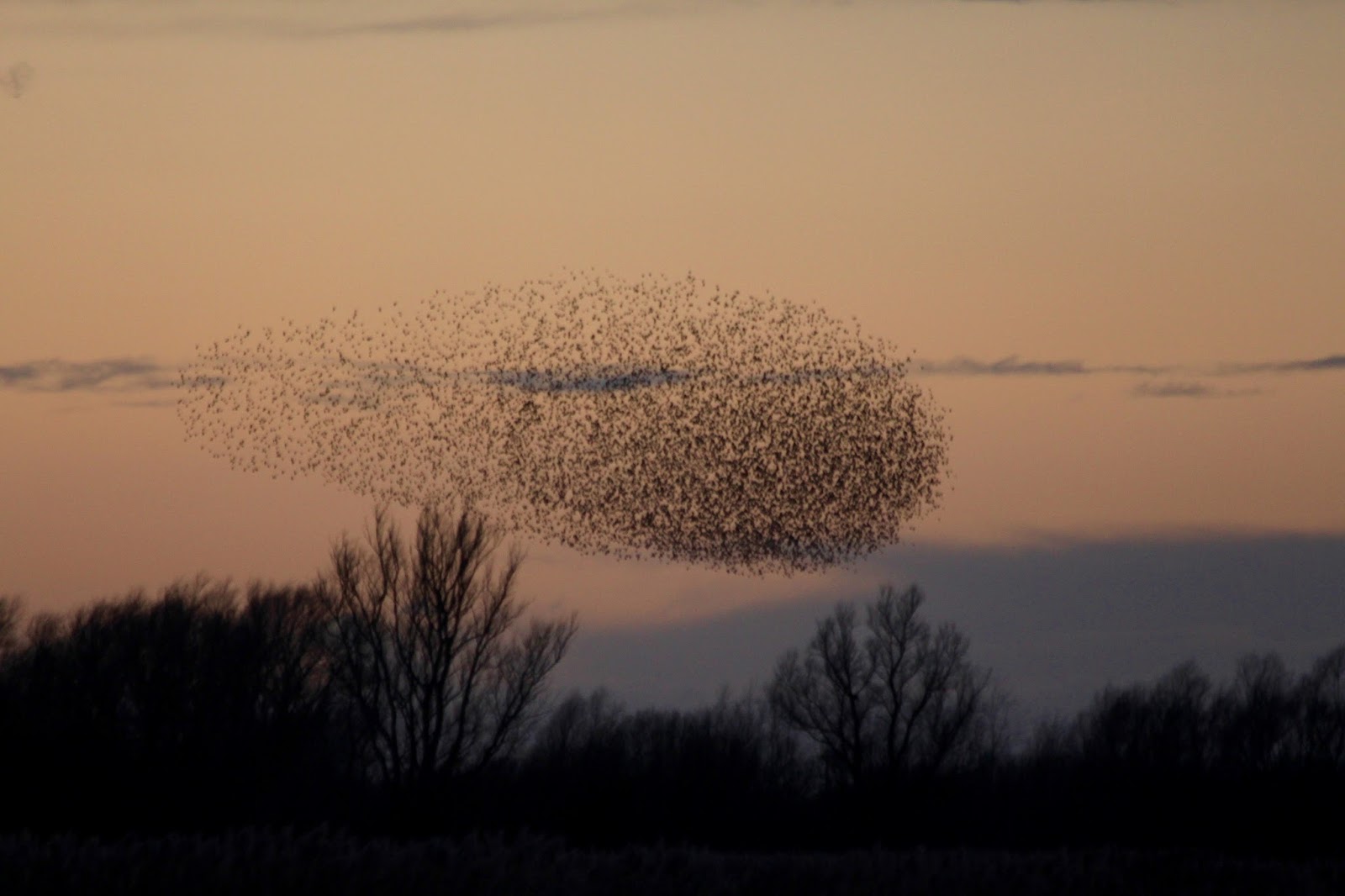
As we were about to leave, I noticed out of the corner of my eye a fluid black mass dancing in the sky, far in the distance. A mighty murmuration of thousands of starlings was sweeping through the air, each bird synchronised with the one beside it, as though all the birds had combined to become one entity. As this was my first murmuration sighting, I was particularly enthralled. The mass twirled throughout the sky, becoming at times nearly invisible and then suddenly bold and inky as they turned all at once in their harmonised flight. Gradually the mass decreased, as from time-to-time small groups broke off and shot down into the trees to go to sleep. We kept anticipating that the whole conglomeration was about to disappear as they would teasingly dip close to the treetops, but then at the last minute shoot up again. As we watched enraptured, it was suddenly as if a responsible starling had called “LIGHTS OUT IN 5 MINUTES!” because the airborne assembly all at once dived for the nearest woodland canopy. The starlings knew that it was time for bed and had sunk into the trees to roost for the night. We took their departure as a cue for us to leave.


This is one of the things that I love about nature – its unpredictability. We had come out with our minds set on finding owls, but were also treated to one of the most beautiful, entrancing, and moving displays that this country has to offer, on a reserve which isn’t even famous for its spectacular murmurations. It just goes to show that you shouldn’t immediately lose heart if your target species is being elusive – there might be something even more spectacular just around the corner.


Sunday, 15 November 2015

Compensation Culture

Cambridgeshire has not always been my local patch; I spent my teenage years living in a small village just outside Cardiff. South Wales is a beautiful place with a rich history, it’s not hard to see why Welsh people often feel so connected to their fatherland. It is a land where rolling verdant hills meet wild gushing rivers. When people think of South Wales they may be inclined to picture pit-marked valleys undulating around tight-knit communities, with sheep grazing the fertile fields. Parts of the region do indeed live up to this stereotype, but there is another side to the place, one that has propelled itself into the 21st century with as much vigour as any other modern, vibrant city.


Cardiff serves as not only a centre of devolved power (housing as it does the Welsh Assembly), but also a hub of the arts, sport and finance in Wales. As you have probably guessed, I’m a country girl, but as cities go Cardiff is one of the more pleasant. It is compact enough not to feel like an urban sprawl, and has more than your average concentration of green areas.


But don’t be fooled into thinking that, unlike anywhere else, Cardiff hasn’t had its fair share of tension between nature and economic development.

Cardiff Bay is a paradise for tourists, it houses the world-famous Millennium Centre (particularly famous as the home of Welsh opera), contains more restaurants and cafés than you could ever visit and is set in a stunning location at the side of a freshwater lake.


The problem is that the freshwater lake didn’t use to exist. Although once a thriving dock, Cardiff Bay fell into disrepair in the 20th century. No longer useful, it was simply seen as unsightly. With an extremely high tidal range, the Bay’s mudflats would lie exposed for as much as 14 hours a day. These were a fantastic habitat for waders and waterfowl, but potential investors saw them as ugly.


In the 1980s a proposal was made to build a barrage across the Bay, where the rivers Taff and Ely meet, thus creating a more aesthetically pleasing body of water and attract investors to the area.

As you can imagine, this didn’t go down well with conservationists who recognised the value of the mudflats that would be destroyed by the barrage. At this time the EU Habitats Directive had not yet been adopted but was in discussion. The Severn Estuary, including the Bay, had been proposed as a Special Protected Area during the discussions but was not formally protected by the Directive.


The Habitats Directive was passed by the EU in 1992 but in 1993 the Cardiff Bay Barrage Act was passed to allow the construction of the barrage, on the grounds of over-riding public economic interest – one of the get out clauses of the Habitats Directive. And with that the construction of the barrage started in 1994, was finished in 2000, and the mudflats were lost.

The Habitats Directive does state that habitat compensation must be provided in cases where the Directive is over-ridden. In the case of Cardiff Bay this was provided on the nearby Gwent Levels. A small wetlands reserve was also added right next to the Bay.


Last weekend we went to visit my mum, who still lives in Cardiff, and decided to take a trip to the Cardiff Bay Wetlands Reserve to see how it was doing. It was a particularly chilly day which felt like it belonged more to winter than autumn. The leaden sky hung heavy above us and the air was damp with fine drizzle. Luckily, it was fairly still so most of the wildlife did not seem put off by the dismal weather.

As we approached the entrance to the wetlands reserve we could see the developed Bay to one side and crowds of racing sailing boats to the other. The wetlands feel like an oasis of stillness amongst a lively nerve centre of activities. Herring gulls, black-headed gulls and lesser black-backed gulls flew overhead, distinctively calling as they went. It was hardly surprising to see them this near to the coast.


The reserve lies at the edge of the freshwater lake, alongside neighbouring residential areas. It is made up of boardwalks interspersed among pools and reedbeds, accompanied by a token patch of wildflowers.


At first we could only see the gulls but the information boards assured us that the wetlands are popular amongst resident and migratory water birds so we pushed on. Only a few metres into the reserve we caught sight of a speedy flash of blue and green sweeping away from a pond – a kingfisher! This was a good start. As we wandered over to where he had appeared from we saw that the pond was absolutely teaming with fish, flashing silver as they darted around below the surface.

Coots screamed out at each other from between the reeds, alerting us to their presence. Moorhens, too, placidly swam about the pond, dipping their comical red and yellow beaks below the surface intermittently to scout for food.


Above the pond a lone robin sat on a bare branch, surveying his territory and watching us with curiosity. He was silhouetted against the ashen sky, giving him an air of authority over the pools below.


Continuing along the boardwalk as it turns out towards the freshwater lake, in the distance we could see stately mute swans placidly swimming amongst elegant great-crested grebes.

Ubiquitous mallards floated upon another isolated pond. Beside them were two bulky hybrid ducks standing on rocks and looking particularly imposing over their slighter acquaintances.


A grey wagtail zipped with impressive speed between the reeds and onto the muddy banks below, his saffron underside making him conspicuous aside the murky earth.

One cannot say that birds have rejected this human constructed reserve. There are clearly birds here that rely on this new habitat. But the real question is whether it and the reserve on the Gwent Levels have provided genuine compensation for the important habitat lost by the barrage construction. More research is needed to determine the long-term effects of the habitat change but the act of destroying rare habitat, essential for specialist waders, is highly concerning.


The situation may not be perfect but at least the EU Birds and Habitats Directives are in place to block other developments which threaten to trash irreplaceable environments. The most worrying thing now is that the Directives are under threat due to the European Commission’s review to determine whether they are still “fit for purpose”. On 20th November a conference will be held in Brussels to discuss the findings of the evaluation. It is easy to feel helpless and assume that only politicians have any control over the outcome of the “Fitness Check” but there is no point becoming complacent. The RSPB and other nature charities have campaigned against changes and are educating the public about the importance of the Directives. They have encouraged over 100,000 UK residents to respond to the Commission consultation to say that the Directives are appropriate and necessary. We can only hope that together we can dispel the myths proffered by politicians that the Directives are damaging to businesses, and rely on our political leaders to represent our views at the conference at the end of November.


Tuesday, 3 November 2015

Hinchingbrooke: An Artist's Interpretation of Autumn

It was some time ago that we first heard about Parkrun. If you’re not familiar with it, Parkrun organises free Saturday morning timed 5k runs at loads of different locations both in the UK and abroad. Being outdoorsy types, we had always fancied giving it a go but had never quite got round to it. Four weeks ago we decided that the time had come, so we laced up our running shoes and headed to Hinchingbrooke Country Park in nearby Huntingdon. And we are so glad we did! There’s nothing better than getting up early on a crisp weekend morning and joining crowds of lovely, energetic fellow runners to jog around a beautiful lakeside, woodland setting.


The only problem with running through this stunning place is that it’s hard to appreciate it in detail. So we decided to take a trip to Hinchingbrooke on Sunday afternoon and mosey along at a slightly slower pace.


The woodland at Hinchingbrooke currently looks like an artist’s interpretation of autumn. We wandered along the thick crunching carpets of gold and amber leaves, under mature trees which still retained the last traces of their fading foliage. The low autumnal sun shed warm light through the emptying boughs and illuminated the textured bark. The great diversity of mostly native trees made the place feel like a snapshot from history. The pinnate leaves and delicate keys of ash lay on the ground mixed with the five-pronged saffron-hued leaves of field maples, while above the elders stood proud with their bounties of berries. The oaks, adorned with plump acorns, still retained the majority of their now chestnut-toned leaves, but soon both acorns and leaves will drop and the oaks too will be left bare. In not too long the Scots pines will be left as the sole bearer of green foliage.


Woodlands will always hold a special place in our hearts. Trees manifestly display the changing faces of the seasons and provide us with a sense of something greater than ourselves. Natural and sustainably managed woodlands are not only vital as homes for a myriad of creatures, from large mammals to nearly invisible insects, but they are also essential in absorbing the CO2 and pollutants that humans are emitting, and reducing rainwater run-off which decreases the risk of flooding. But time and time again around the world we chop them down in favour of agriculture, housing and timber, amongst other things. Trees silently do their bit for the planet, and it’s certainly time for each of us to do our part in conserving them.