Saturday, 22 August 2015

Coming Home to Wildness

There is something awakening, bracing, enlivening about an encounter with true untamed wildness. It is a feeling that we can rarely experience in this country, deprived as it is of large expanses of completely untouched countryside by continual residential or industrial developments. But when you do feel it, it is like coming home. It is as if our bodies and minds are greeting an old friend which they have lost contact with. As the warmth of the sun kisses our skin, the wind’s breath caresses our limbs and our eyes feast on nature’s feral beauty, we realise on an elemental level just what we have been missing.


While this sense of wildness is scarce in our cultivated land, there are places within reach which give us a taste of the natural world’s breathtaking, awe-inspiring, spine-tingling undomesticated form.


One such place in our patch is Wicken Fen. This magnificent, wind-beaten, wildlife abounding area of wetland provides a window into an all but lost landscape. Wicken Fen is one of the last remnants of undrained fenland. The vast majority of the low-lying marshy fens were drained several hundred years ago but the National Trust has committed to maintaining areas of currently undrained fen and rewetting other areas to create a rich network of wetland habitats.


The success of Wicken’s naturally managed landscape is proven in its impressive evidence of 9,175 recorded species. It is home to species ranging from wetland-loving plants such as Fen Bedstraw (Galium uliginosum) and Hemp-agrimony (Eupatorium cannabinum), to birds of prey such as Hobbies and Hen Harriers, and from reptiles such as Common Lizards to a vast variety of insects including a huge range of butterflies, dragonflies, damselflies and beetles. It is impossible to do justice to the wealth of wildlife at Wicken with just a short summary, I would really recommend visiting the reserve to appreciate its diversity.


We humans may use energizing experiences of the elements as a way of bringing ourselves back in touch with nature and escaping the rat-race, but these species have never had the chance to lose contact with their natural state of being. For us, encounters with true wildness are awakening, but we can learn a lot about how to live from creatures for whom wildness is just a way of life.


Sunday, 16 August 2015

A View from the Bridge

Just days after I posted last about the wonders of Odonata, we were given another glimpse into their incredible lives.


After a week of inclement weather which probably made the local wildlife wonder whether it really was summer after all, we set out for a stroll at Milton Country Park on a seasonably warm afternoon under a sky which was draped with only a few benign wisps of cloud. We hoped that this sudden change in weather would encourage the park’s animals out of their hiding places.


Thousands of people drive past Milton Country Park every day while commuting on the infamous A14, but many don’t know it is there. Set back from the road and hidden by thick rows of trees, the park is a verdant oasis amidst some of the busiest roads and one of the most bustling industrial areas of Cambridge. The area was formerly filled with gravel pits but has been transformed into an expanse of wetland in which a multitude of wildlife thrives.


As always, we were treated to a myriad of sightings of water birds such as moorhens, swans and great-crested grebes, all of which were with young – somewhat older and less awkward than a couple of months ago but no less adorable. But as we passed over one of the park’s many quaint bridges overlooking the edge of a lake we saw something different, something we hadn’t seen there before.


A female Brown Hawker dragonfly was hovering close to the water, carefully surveying the area. At first it appeared that maybe she was hunting, but what happened next felt really special. She wavered nearer to the water, until she was just a couple of centimetres above it, and then gently dipped her tail under the surface. It was then that we realised that she was ovipositing!


She stayed in the same spot for a few minutes, laying her eggs in the water, before moving slightly to a position just above the water’s edge. Here she deposited more eggs, but this time into the mud on the bank, rather than directly into the water itself.


This is just the start of a fascinating process. Once her eggs hatch, they will remain underwater in their larval stage for a number of years before emerging from their aquatic world and undergoing a final moult to become adult dragonflies. Their adult stage in comparison is only a brief chapter in their lives, lasting just a few weeks.


So next time you’re near a calm body of freshwater, just stop for a moment and take a closer look, and you too may catch sight of a female dragonfly laying her precious eggs. It really is a sight to behold.

Thursday, 13 August 2015

An Ode to Odonata

A deadly voracious predator with the ability to reach speeds of 30 miles an hour, move their wings independently and catch insects in flight. A graceful enchanting flyer decorated with a range of iridescent rainbow hues. It may not sound as though I am talking about the same creature in these two sentences but that is part of the beauty of dragonflies and damselflies, they are intimidatingly impressive yet exquisitely elegant.

Blue-tailed damselfly

Since the beginnings of their ancestors in the Late Carboniferous period, the Odonata (the taxonomic order which consists of dragonflies and damselflies) have been a strong presence in marshes and wetlands. They are incredibly widespread and have colonised every continent with the exception of Antarctica.

Mating Common Blue damselflies

Their dazzling adult form is tragically transient and lasts merely days or weeks. Most of their lifecycle is spent underwater in their nymph form. Although immature, the nymphs are none-the-less impressive hunters and can dominate a freshwater ecosystem with their aggressive predation skills.

Common Blue damselfly

Living near fenland, we are lucky enough to have a number sites in close proximity that are teaming with dragonflies and damselflies. Two of the best are Wicken Fen and Paxton Pits. With abundant areas of clean freshwater, rich with vegetation, they both provide the perfect conditions for these incredible insects to lay their eggs and for their nymphs to live until they are ready to emerge as adults.
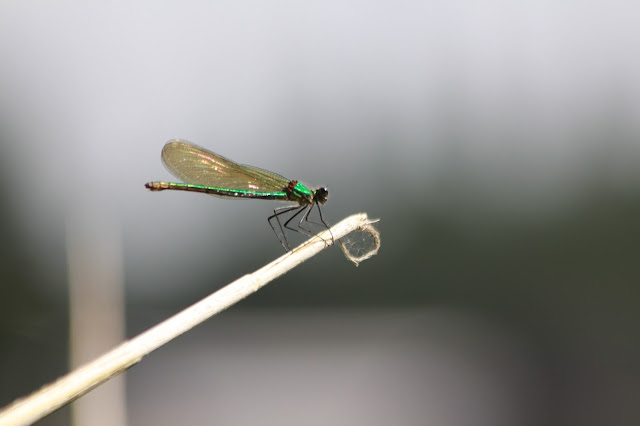
Female Banded Demoiselle

Many Odonata are sexually dimorphic which can make identifying them trickier but, then again, doesn’t that just add to the fun? One of the damselflies that we see most often, the Banded Demoiselle, is a perfect example of this. The name is apt for the male who has distinctive dark patches on his wings which shimmer like black velvet alongside his azure body. However, the female does not display any of the bands which provide her name. She has clear wings and a striking emerald body.

Male Banded Demoiselle

The male Banded Demoiselle is one of the easiest damselflies to identify seeing as there are only two British species that appear to have coloured wings and the other, the Beautiful Demoiselle, has fully tinted wings, without any bands.

Female Banded Demoiselle

Another species of damselfly which regularly makes an appearance on our walks is the Common Blue. This dainty electric blue hued beauty is easily confused with the Azure damselfly. If you look with binoculars or manage to get a good photo the identification becomes easier as there are differences in the pattern of the antehumeral stripes on their thoraxes.
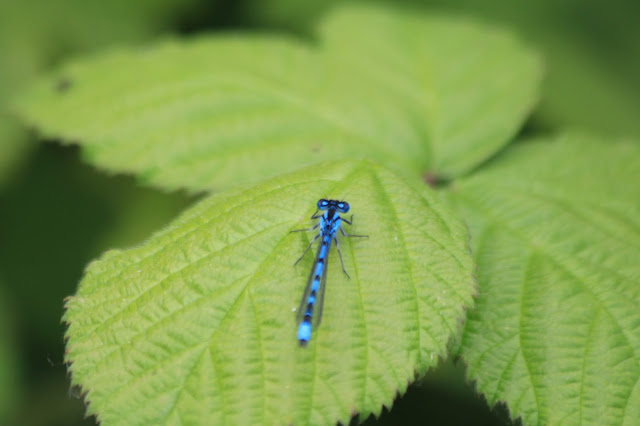
Common Blue damselfly

But enough of these diaphanous damselflies and on to the beasts of the Odonata world – the dragonflies. Without much knowledge of different species, by sight they can generally be distinguished from damselflies by their larger, sturdier form. While they are at rest another hint which will help you distinguish them is to look at the position of their wings. Damselflies hold their wings alongside their body while resting, while dragonflies position their wings out from their body. Perhaps a more subtle difference to the naked eye is the relative size of their wings to each other. While damselflies’ front and rear wings are similar in size, dragonflies rear wings are wider than their front wings.


Damselflies may look deceptively placid but, with their imposing size and strong flying skills, dragonflies are unmistakably dynamic and charismatic. The Ruddy Darter cuts a particularly striking figure alongside the undrained fenland on Wicken’s Sedge Fen trail. This species’ searing scarlet body flashes brightly against the sepia toned fenland vegetation, arousing images of the bleakly beautiful wildness of the place.

Ruddy Darter

The Four-spotted Chaser is another striking, glitzy dragonfly which resides at Wicken Fen and in much of the UK. As it hums past in a bronze blur you may not notice its most dazzling feature, but as it gently rests upon the wetland flora you will easily see how it procured its name. About halfway along and near to the tip of the leading edge of each otherwise clear wing it has eye-catching ebony patches.

Four-spotted Chaser

Subtler, yet no less extraordinary, is the Black-tailed Skimmer. We spent an hour or so basking beside one of the picturesque lakes at Paxton entranced by the aerial acrobatics of this dragonfly and its gorgeous colourings which intensify down its body in an ombré fashion from light blue to black.

Black-tailed Skimmer

In the past I generally admired dragonflies and damselflies for their ephemeral beauty and impressive forms without paying too much attention to species, but as I have dipped my toe into actively identifying them over the past few months I have developed an even greater appreciation of these fascinating creatures. Whether you are bewitched by their stunning patterns, their intriguing behaviour or their stimulating ecology, it is impossible not to adore these luminaries of the insect world.

Black-tailed Skimmer

Monday, 3 August 2015

The Butterfly Enchanted Foxley Woods

Norfolk is such an enchanting county. With landscapes which range from picture-perfect beaches and spectacular cliffs, to the low-lying Fens and vast wetlands, it is the perfect British holiday choice. Sometimes I forget just how close it is to us but, in reality, at not even an hour’s drive from our house on the west of Cambridge to the outskirts of Norfolk, I think we can arguably describe it as being within our patch.


There are so many places that I could recommend visiting in Norfolk, but one location that is particularly special to us is Foxley Woods. This woodland is thought to be round 6,000 years old and is home to a vast array of exciting wildlife.


If you have read my earlier posts, you will know that I have set myself a butterfly photography challenge. Seeing as Foxley Woods is known for its impressive number of butterfly species, I thought that this would be a great place to hopefully snap some more specimens.


Just like in our local woods, as I described in an earlier post, Foxley Woods contains some perfect butterfly friendly clearings which cut through groves of tall trees and are flanked by a multitude of wildflowers.


The day before our most recent visit we had been at Pensthorpe Natural Park where, in the wildflower meadows, I had stalked a Comma in hope of getting a photograph. I tried for about ten minutes as it flitted from flower to flower, before eventually flying out of sight. Having only walked about ten metres from the car at Foxley, a Comma dipped onto a flower right in front of me. Determined not to be left without a photo again, I mentally readied myself for a long pursuit. However, to my delight and surprise, he fluttered to a nearby twig where he rested patiently for about ten seconds, allowing me to capture my much sought after photo. Commas are so named because of the small white curve on the underside of each wing which resembles the eponymous punctuation mark – it is pretty subtle but that makes it all the more fun to look out for. They are beautiful butterflies to glimpse, with their vibrant flame-hued scallop-edged wings, pigmented with dark flecks.


The next new butterfly we came across was somewhat less perky looking than the comma who had practically danced before me. As we meandered along the verdant dewy path through the thickets, a small brown mottled butterfly settled on a leaf nearby. From the creamy dots and distinctive pattern of eyespots on his back, we could tell instantly that he was a Speckled Wood. Unfortunately, he was a bit of a sorry looking specimen. The backs of his wings were torn in an almost symmetrical fashion, making it look as though he had probably narrowly escaped from a close encounter with a bird. Amazingly, despite his mangled wings, he was still able to fly, and mere moments after he had settled in front of us, he shot up again into the canopy out of sight.


I was pretty happy with photographing these new species alone, but I managed to end the day on a greater high. The White Admiral is considered by many to be Foxley Woods’ star species and it was certainly the star of my day. I noticed it out of the corner of my eye and instantly knew that it was not a butterfly I had seen already. The White Admiral has a distinctive measured and graceful way of gliding that sets it apart from some of the more frantic flutterers. Its rich brown or black dorsal surface is streaked with bold white strips. Foxley Woods is known as a great place to look for this butterfly. Although it is not uncommon in Norfolk, it is said to be declining, so sightings such as these still feel truly special.


On the same day we saw many other butterflies such as Meadow Browns, Ringlets, Gatekeepers, Small Whites and Small Skippers, but seeing as my aim is to photograph all the UK’s butterfly species, these new three were particularly exciting.


The tally now stands at 8 species of photographed butterflies. It’s a start but there’s a long way to go!

Foxley Woods
Comma
Speckled Wood
White Admiral

Local Woods
Gatekeeper
Meadow Brown
Ringlet
Small White
Small Skipper